

First, the office table height standard: ergonomic precision calculations
Ergonomics reveals: the ideal desk height should make the elbow naturally drooped at 90 degrees, knee bend 90 degrees and feet flat on the ground, the spinal pressure in order to effectively dispersed. Static 72 cm standard desk height is actually a health trap - it forces the human body to adapt to the furniture rather than vice versa, ultimately leading to compensatory posture distortion.

Individualised calculations are available:
Sitting height = Height (cm) ÷ 2.48 (approx. 68.5 cm for 170 cm)
Standing height = Height (cm) ÷ 1.58 (approx. 107.6 cm for 170 cm)
A finer consideration needs to be incorporated into limb proportions: the true fit zone for a standing desktop is when the elbow height above the ground (average 108.7cm for men, 107.0cm for women) is subtracted from the thickness of the desktop support, which is 25-38mm.
Second, standing desk: health innovation or excessive marketing?
The rise of sit stand desk directly refers to the hazards of sedentary - studies have confirmed that people who sit still for more than 6 hours a day, the risk of heart failure and premature death doubled. Alternating between standing and sitting significantly reduces these risks by improving circulation and easing muscle tension. Blood glucose studies further support the idea that standing after a meal helps blood glucose return to normal more quickly.
But standing is not a cure-all. Studies of human energy metabolism have poured cold water on the problem: standing burns only 8 calories more per hour than sitting, and standing for 6 hours is worth the calories in a slice of bread. What's more, standing continuously induces new problems:
⚠ Sudden increase in venous pressure in the lower limbs, aggravating the burden on the knees and ankles
⚠ Static loads on the lumbar spine can cause aches and pains
Ideally, the solution is to alternate dynamically: experts recommend switching between sitting and standing every 30-60 minutes, with a single stand lasting no more than 30 minutes!
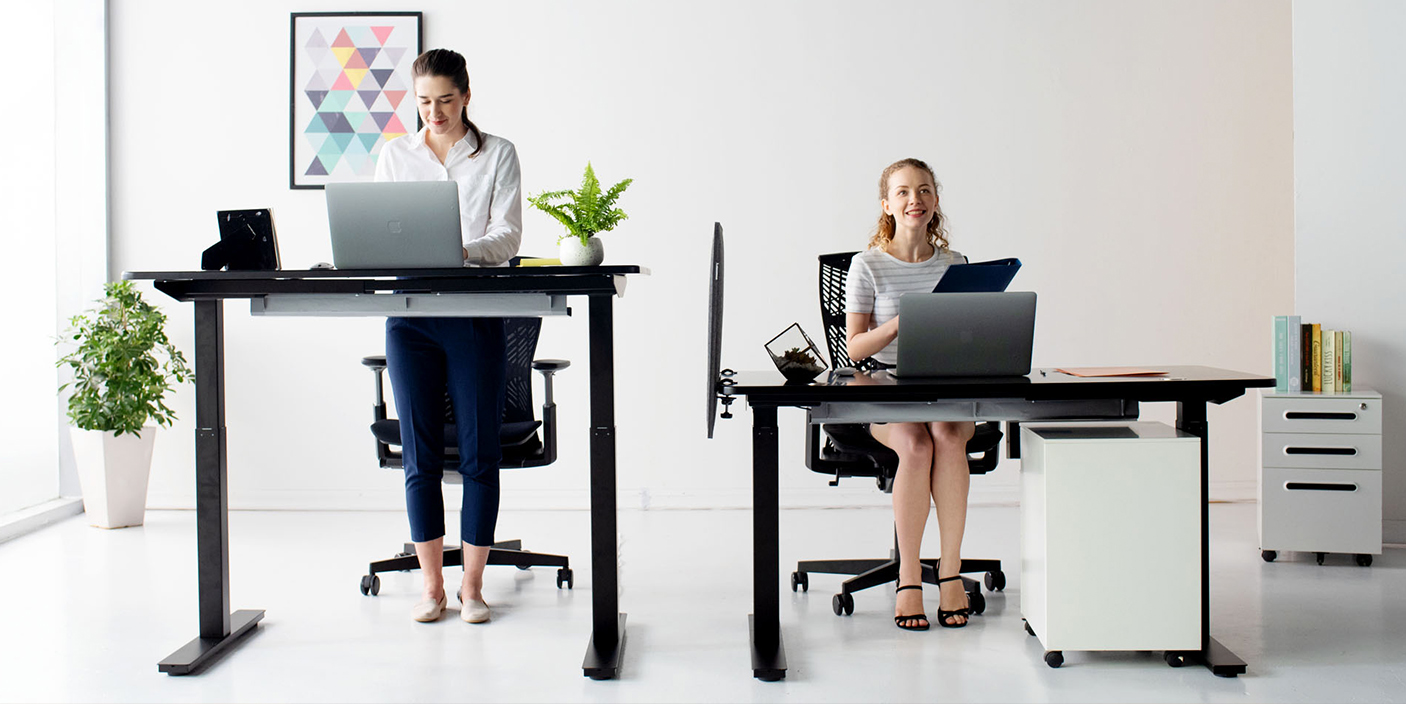
Third, the construction of ergonomic workstation practical guide
Electric standing desk (adjustable range of 72-125cm) by virtue of the memory preset function to become the first choice, its flexibility to crush the manual models and fixed tables. Systematic adjustments are required for the setup:
Table Colleges and Universities
Sitting posture: thighs parallel to the ground, forearms horizontal to the table
Standing posture: elbows bent at 90 degrees, shoulders relaxed and no shrugs
Fourth, the future of healthy office: find balance in the flow
The essence of ergonomics is dynamic adaptation - there is no eternally correct posture, only continuous changes in posture. 2025 leading electric desk such as Upliftec has integrated Bluetooth and voice control. The APP records the frequency of posture switching and guides the user in scientific rotation.
A truly healthy office ecosystem goes beyond the desk and chair: 5 minutes of micro-exercise (stretching or walking) interspersed with every 45 minutes reduces the risk of premature death by 17%, and by 35% when high-intensity intervals are added. The data confirms that alternating work rhythms activate the metabolism and creativity better than standing alone!